Keeping your workplace safe, compliant and prepared involves more than simply having equipment available. Businesses need to understand the risks associated with the substances they store and handle, have suitable control measures in place and ensure employees know what to do if an incident occurs.
This guide is designed to provide straightforward, practical information, the series will explore some of the key areas businesses should consider when reviewing spill preparedness, hazardous substance storage, environmental protection and site safety.
Understanding Your Responsibilities
Under the Control of Substances Hazardous to Health Regulations 2002 (COSHH), employers are required to assess risks arising from hazardous substances used within the workplace. HSE guidance states that these assessments should also consider arrangements for accidents, incidents and emergencies, including serious spillages, as well as risks associated with the storage, handling and disposal of hazardous substances.
For businesses storing dangerous substances, HSE guidance also highlights the importance of appropriate storage arrangements, emergency procedures, employee training and regular reviews of the controls in place.
Being prepared therefore starts long before a spill occurs.
Is Your Site Ready to Respond?
Businesses should understand which liquids are present on site, where they are stored and handled, and what could happen if a container leaks or a spill occurs.
HSE guidance on chemical storage recommends having suitable spill control materials readily available and ensuring they are appropriate for the substances being stored. Examples referenced by HSE include absorbent materials, sealing putties, booms and other measures for containing and clearing smaller spills where it is safe to do so.
This means considering whether your site has the correct spill kits, absorbents, drain protection and containment equipment positioned where it could be needed.
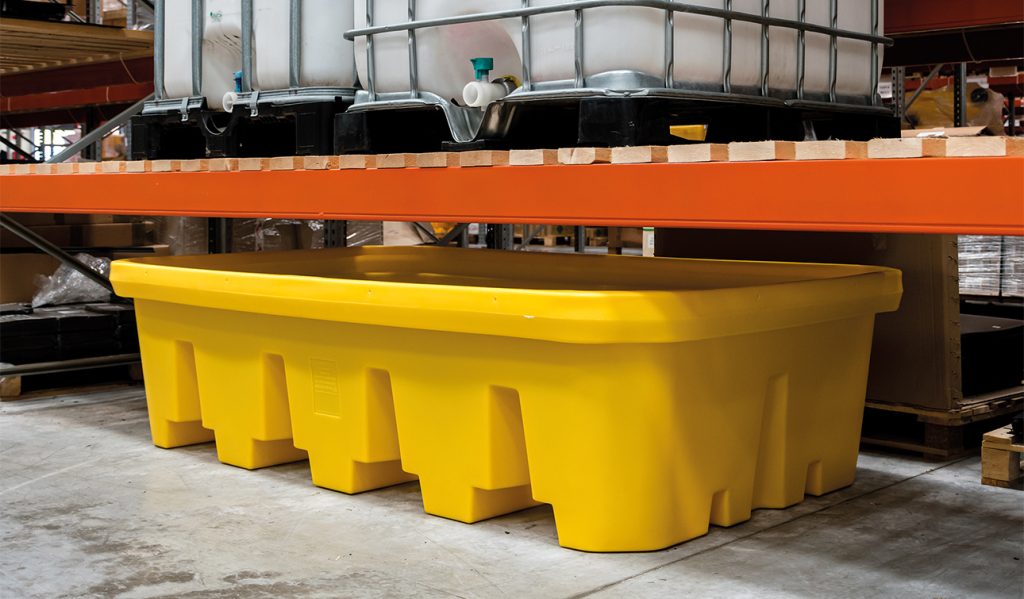
Where drums, IBCs or other liquid containers are stored, suitable secondary containment such as spill pallets, bunds and drip trays can also help prevent leaks or spills from spreading into surrounding areas.
Preparation Goes Beyond Equipment
Guidance emphasises that spill control procedures should be communicated to employees expected to respond to an incident. Businesses should therefore ensure staff understand where response equipment is located, how it should be used and what procedures should be followed.
Regular inspections can also help identify missing absorbents, damaged containment equipment, unsuitable storage arrangements or changing risks within the workplace.
Helping Your Business Stay Better Prepared
Throughout our Better Prepared series, we will break down key topics including choosing the correct spill kit, secondary containment, protecting site drains, hazardous substance storage and improving spill response procedures.
Each guide will combine practical advice with relevant industry and HSE guidance, helping businesses better understand the measures they should consider across their sites.
At Hyde Park Environmental, our aim is simple: provide straightforward expertise and practical solutions that help businesses reduce risk, protect their sites and stay better prepared.
Keeping your workplace safe, compliant and prepared involves more than simply having equipment available. Businesses need to understand the risks associated with the substances they store and handle, have suitable control measures in place and ensure employees know what to do if an incident occurs. This guide is designed to provide straightforward, practical information, the […]
Intermediate Bulk Containers (IBCs) are commonly used across manufacturing, engineering, utilities, construction and other industrial environments to store oils, chemicals and hazardous liquids. While they provide a practical way to store larger volumes, they can also present significant risks if leaks, spills or damage occur.
Safe IBC storage should therefore consider more than simply where containers are positioned. Businesses should understand the substances being stored, assess the risks they present and ensure appropriate controls are in place.
Under the Control of Substances Hazardous to Health Regulations (COSHH), employers are required to assess the risks associated with hazardous substances, including those arising from their storage, handling and disposal. HSE guidance also highlights the importance of considering arrangements for accidents, incidents and serious spillages.
Safety Data Sheets should form an important part of this process. They provide information on the hazards associated with a chemical, alongside guidance on handling, storage and emergency measures. However, HSE makes clear that an SDS does not replace a workplace risk assessment; instead, the information should be used to inform one.
Why is bunded IBC storage important?
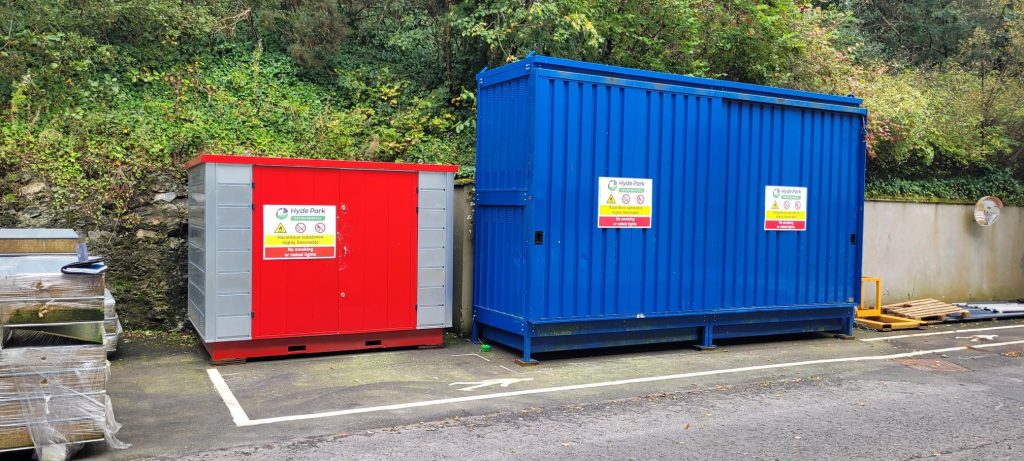
Secondary containment provides an additional layer of protection should an IBC leak, become damaged or fail. A suitable bund can help prevent liquids spreading across operational areas, entering drainage systems or contaminating the surrounding environment.
For oil storage covered by the relevant regulations in England, secondary containment holding multiple IBCs must generally provide capacity equal to whichever is greater: 25% of the combined storage capacity or 110% of the largest container. Requirements can vary depending on the substance, location and application, so businesses should always consider the regulations and guidance relevant to their own site.
Flammable liquids may require additional consideration. HSE's HSG51 guidance specifically covers the storage of flammable liquids in workplace containers of up to 1,000 litres and focuses on identifying and controlling fire and explosion risks.
Putting safer IBC storage into practice
For sites storing multiple IBCs, the HST5600 8 IBC Dual Purpose Bunded Storage Unit provides a robust and practical way to keep hazardous liquids securely contained in one dedicated area. With capacity for up to 8 x 1,000 litre IBCs, a 2,200 litre fully welded leakproof sump, lockable sliding doors and flame-arrested ventilation, it is designed to support safer storage, improved site organisation and stronger spill control.
Looking to improve IBC storage on your site? Check out the HST5600 8 IBC Dual Purpose Bunded Storage Unit on our website to view the full product details and specifications.
Intermediate Bulk Containers (IBCs) are commonly used across manufacturing, engineering, utilities, construction and other industrial environments to store oils, chemicals and hazardous liquids. While they provide a practical way to store larger volumes, they can also present significant risks if leaks, spills or damage occur. Safe IBC storage should therefore consider more than simply where […]
As autumn approaches, aerospace facilities face a changing set of site conditions. Increased rainfall, wetter external areas and colder weather can place additional pressure on spill response, hazardous substance storage and overall site safety.
Across aircraft maintenance, manufacturing and engineering environments, fuels, oils, hydraulic fluids, chemicals and other liquids are routinely stored and handled. Taking time at the start of the season to review how these materials are contained and how quickly a spill could be controlled can then help facilities stay prepared for the months ahead.
Here are five essential compliance products aerospace facilities should consider as part of an autumn site review.
HUG absorbents, pads, and spill kits are essential for safely containing and cleaning up aviation fuels, oils and hydraulic fluids. This is particularly important as wetter autumn conditions can increase the risk of spills spreading across external areas, workshops and hangars. under both the Control of Substances Hazardous to Health (COSHH) Regulations 2002 and the Environmental Permitting (England and Wales) Regulations 2016. These laws require that hazardous substances are properly controlled and that any accidental releases are managed to prevent environmental contamination.
Bunded storage units, containment trays, and leak control systems are also vital to effective environmental management. Autumn is a useful time to inspect bunded areas, particularly external storage locations that may be exposed to heavier rainfall and changing weather conditions. The Environmental Protection Act 1990 and the Air Navigation (Environmental Standards) Order 2002 both reinforce the need for facilities to minimise emissions and prevent pollutant discharge. Bunded containment ensures that any leaks are captured before they reach the environment, safeguarding both airfield operations and surrounding ecosystems.
Drain covers and drain protection products become particularly important during the wetter autumn months. Increased rainfall can allow spilled fuels, oils or chemicals to travel more quickly across hardstanding and towards surface-water drainage systems. Keeping suitable drain covers, seals, plugs or spill barriers close to higher-risk areas can help prevent pollutants from entering drains while a spill is being contained and cleaned up. Aerospace facilities should pay particular attention to drains located near fuel handling areas, chemical storage, loading points, maintenance zones and external storage areas.
To protect employees working with chemicals, COSHH-compliant hazardous storage cabinets and emergency decontamination showers are indispensable. As sites move into colder and wetter months, it is also important to ensure hazardous substances remain securely stored, organised and protected from unsuitable environmental conditions. The Health and Safety at Work etc. Act 1974 and COSHH Regulations mandate that personnel handling hazardous materials must have immediate access to protective and decontamination measures, making these products a regulatory and ethical necessity.
Finally, environmental monitoring and waste management systems support aerospace organisations in meeting requirements from schemes such as CORSIA (Carbon Offsetting and Reduction Scheme for International Aviation) and the Civil Aviation (Environmental Protection) (Amendment) Regulations 2024. These frameworks place continued emphasis on measurable emissions reductions, responsible waste management and accurate environmental reporting. Reviewing these systems as part of an autumn aerospace site check can help facilities identify potential gaps and prepare their environmental controls for the colder months ahead.

Prepare Your Aerospace Site for the Season Ahead
Autumn preparation doesn’t have to mean changing everything on site. Often, it starts with reviewing the controls already in place. Check that spill kits are stocked and accessible, storage and bunding remain in good condition, drain protection is positioned near higher-risk areas and employees know where equipment is kept and how it should be used.
For aerospace facilities handling oils, fuels, hydraulic fluids and hazardous substances every day, these simple checks can help strengthen spill preparedness and reduce the risk of an incident escalating during wetter weather.
Hyde Park Environmental supports aerospace organisations with spill response, secondary containment, hazardous substance storage, drain protection and workplace safety solutions.
Preparing your site for autumn? Speak to our team about the spill control and containment measures suitable for your facility.
As autumn approaches, aerospace facilities face a changing set of site conditions. Increased rainfall, wetter external areas and colder weather can place additional pressure on spill response, hazardous substance storage and overall site safety. Across aircraft maintenance, manufacturing and engineering environments, fuels, oils, hydraulic fluids, chemicals and other liquids are routinely stored and handled. Taking […]
Whether it’s a busy engineering workshop, an aerospace facility, a pharmaceutical site or a warehouse and distribution centre, spills can happen wherever liquids are stored, handled or moved. Having the right spill response equipment positioned around key risk areas helps teams react quickly, contain spills at source and reduce the risk of them spreading across the site. Hyde Park Environmental provides a range of spill kits and response solutions designed to support fast, practical clean-up across a wide variety of working environments.
What Is a Spill Kit
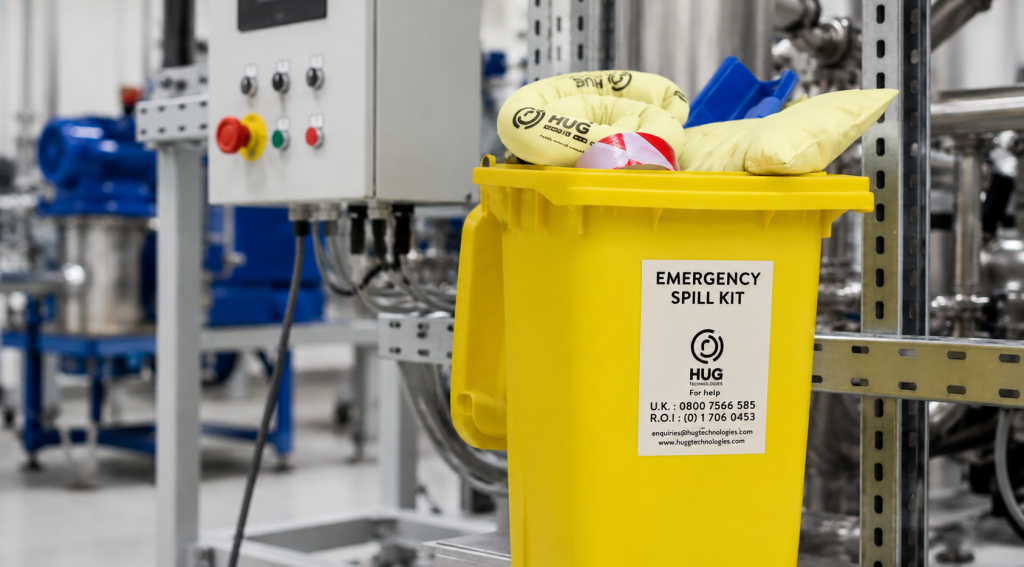
A spill kit is a pre-packaged set of absorbents and tools that allow workplaces to quickly contain and manage liquid spills, from oil and fuels to aggressive chemicals and solvents. These kits act as the first line of defence against spills, helping to control hazards before they escalate into injuries, environmental damage, regulatory violations, and costly clean-ups.
Why Spill Kits Matter
Spills can happen in seconds, but the consequences can last much longer. Left untreated, spills can create slip hazards, damage equipment, contaminate soil and waterways, and expose workers to harmful substances. In many industries, being prepared with the correct spill kit isn’t only a best practice it’s a requirement for compliance with health, safety, and environmental standards.
What’s Inside a Hyde Park Spill Kit?
Hyde Park Environmental offers specialised spill kits designed for diverse scenarios:
Oil-Only Spill Kits: These kits include absorbents that attract and absorb oils, fuels, and petrochemicals while repelling water, making them ideal for workshops, vehicle bays, and marine environments. Contents include absorbent socks, pads, disposal bags, a caution tape roll, and an instructions card.
Chemical Spill Kits: Designed to handle aggressive and non-aggressive liquids such as acids, caustics, solvents, and coolants, chemical kits are essential in labs, processing plants, and manufacturing facilities. They contain chemically resistant pads, socks, disposal bags, and clear instructions for safe use.
Maintenance and Universal Spill Kits: These versatile kits address a broad range of fluids, from oils and coolants to mild acids and water, making them suited to general facility maintenance or mixed-use environments.
Specialty Kits: From acid neutralising kits to overpack drum kits for full-barrel spill containment, Hyde Park’s speciality range supports niche yet critical applications.
Across all kits, common components include:
- Absorbent pads, socks & cushions
- Disposal bags and ties
- Clear instructions and safety guidance
- Optional accessories like drain covers, caution tape, and wheeled bins
Accidents don’t wait and you don’t have to either. Explore the full range of spill kits and find the right solution for your industry today. Shop Hyde Park Environmental Spill Kits & Resources.
Whether it’s a busy engineering workshop, an aerospace facility, a pharmaceutical site or a warehouse and distribution centre, spills can happen wherever liquids are stored, handled or moved. Having the right spill response equipment positioned around key risk areas helps teams react quickly, contain spills at source and reduce the risk of them spreading across […]
Hazardous substances are used every day across warehouses, workshops, manufacturing facilities and maintenance areas. While businesses may have procedures in place for handling these products, the way they are stored can sometimes be overlooked over time.
A regular review of your COSHH storage arrangements can help identify potential issues before they become a bigger problem. Containers may have been moved, stock levels may have increased or hazardous products may simply have ended up being stored wherever space is available.
One question remains; when did you last take a proper look at how hazardous substances are being stored across your site?
What Should You Be Checking?
A COSHH storage review does not have to be complicated. Start by looking at the areas where chemicals and other hazardous substances are regularly used or stored.
Consider:
- Are hazardous substances kept in a clearly designated storage area?
- Are containers clearly labelled and easy to identify?
- Is access restricted where necessary?
- Are incompatible substances being considered as part of your storage arrangements?
- Are containers damaged, leaking or showing signs of deterioration?
- Could a small leak or spill spread beyond the immediate storage area?
- Do employees know where hazardous substances should be returned after use?
Storage requirements should always reflect the substances involved, their quantities and the findings of your COSHH risk assessment.
Secure and Organised Storage Matters
Leaving hazardous products on open shelving, workbenches or in general storage areas can make it more difficult to control access and maintain an organised workplace.
Using a dedicated COSHH cabinet provides a clearly identifiable location for suitable hazardous substances and can support wider workplace procedures.
Our Hazardous COSHH Cabinet measures 1950mm high x 900mm wide x 400mm deep and is manufactured from heavy-duty steel for demanding industrial environments. Its lockable doors help restrict unauthorised access, while adjustable shelving allows the internal layout to be configured around different containers and products.
The high-visibility yellow powder-coated finish and clear COSHH warning signage also make the cabinet easy to identify within busy warehouses, factories, workshops and maintenance areas.

Make COSHH Storage Part of Your Routine
COSHH storage should not be something that is set up once and then forgotten. If your current setup is becoming overcrowded, difficult to manage or no longer provides a clearly designated storage area, it may be time to consider a more suitable solution.
Our HTC001 Hazardous COSHH Cabinet provides a practical and secure storage solution for hazardous substances, helping keep products organised in one clearly identified location. Manufactured from heavy-duty steel, with lockable doors, adjustable shelving and a high-visibility finish, it is designed for everyday use across commercial and industrial workplaces.
Review your current COSHH storage arrangements and make sure the solution you have in place still meets the needs of your site. Explore the Hazardous COSHH Cabinet from Hyde Park Environmental or speak to our team about your storage requirements.
Hazardous substances are used every day across warehouses, workshops, manufacturing facilities and maintenance areas. While businesses may have procedures in place for handling these products, the way they are stored can sometimes be overlooked over time. A regular review of your COSHH storage arrangements can help identify potential issues before they become a bigger problem. […]
Storing flammable liquids safely is essential for protecting employees, buildings and business operations. Solvents, paints, chemicals and other flammable substances can increase the severity of a workplace fire when they are not stored correctly.
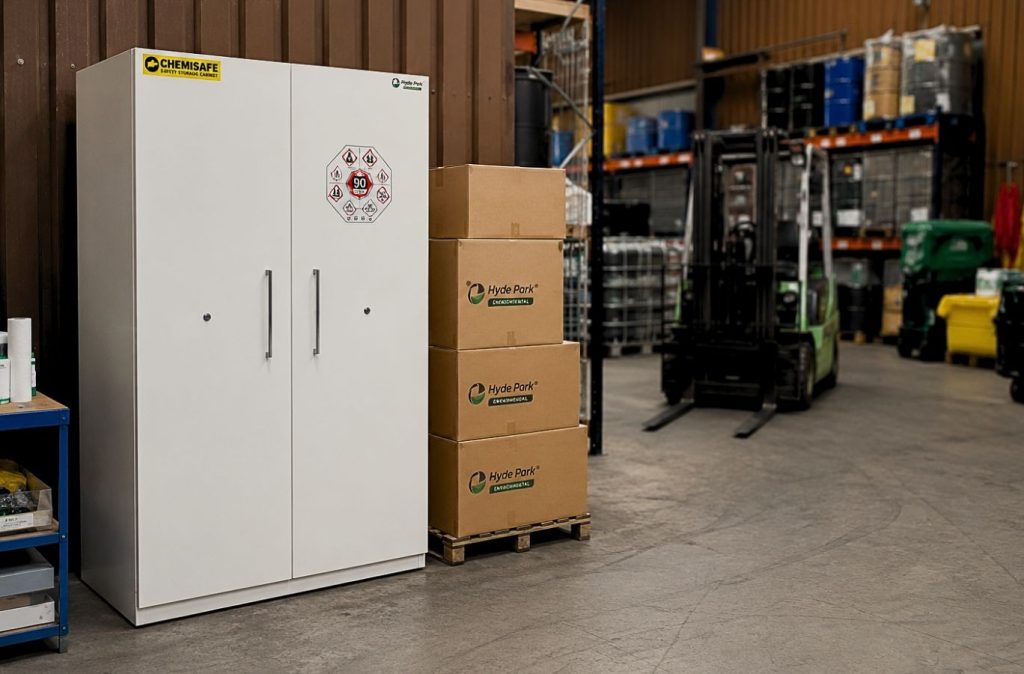
The Type 90 Fire-Resistant Safety Cabinet provides a secure and dependable solution designed specifically for hazardous and flammable materials.
Product Details
This cabinet is manufactured from a cold-bent steel sheet providing a robust and durable storage solution for environments of industrial, commercial, laboratory and sort. The steel is coated with anti-acid epoxy powder before passing through a thermal tunnel at 200°C. This process creates a finish that offers resistance against chemicals, corrosion and everyday workplace damage.
The fire resistance seen inside the cabinet is supported by a specialist insulation system designed to reduce the transfer of heat into the cabinet. The internal panels are also finished in melamine laminate, which provides high resistance against aggressive chemical vapours.
Key construction features include:
- High-density fibre insulation panels suitable for temperatures up to 800°C
- Insulation that is free from ceramic fibre
- Calcium sulphate panels for additional thermal protection
- Internal melamine laminate panels resistant to aggressive vapours
- Durable steel construction with an anti-acid epoxy finish
In the event of a workplace fire, this construction helps delay heat from reaching the substances stored inside. This can provide additional time for employees to evacuate and for emergency responders to control the incident.
Certified to EN 14470-1
The Type 90 Safety Storage Cabinet is certified in accordance with EN 14470-1, the recognised European standard for fire-resistant safety storage cabinets designed for the storage of flammable liquids. This standard sets out strict requirements covering fire resistance, construction, ventilation, spill containment and the performance of key safety components during a fire.
For businesses handling paints, solvents, fuels and other flammable products, choosing a certified cabinet provides greater reassurance than using a standard metal cupboard. It supports safer storage procedures, strengthens workplace fire precautions and helps organisations demonstrate a responsible approach to compliance, risk reduction and the protection of people, property and business operations.
The Right Storage for Flammable Substances
A standard metal cupboard may help keep hazardous products organised and away from general work areas, but it is not designed to provide the same level of fire-resistant protection as a certified safety storage cabinet. In the event of a workplace fire, an ordinary cupboard may heat up quickly, increasing the risk of the flammable liquids stored inside becoming involved in the fire.
The Type 90 Safety Storage Cabinet is specifically designed to delay heat from reaching its contents. Its specialist construction, fire-resistant insulation and certified performance help provide valuable additional time for employees to evacuate and for emergency services to respond. This makes it a far more suitable option for storing paints, solvents, chemicals and other flammable substances.
Hyde Park Environmental supplies dependable safety storage solutions for businesses across the UK and Ireland. Our team can help you identify the most suitable cabinet for your workplace, understand the available specifications and strengthen your approach to flammable liquid storage. Speak with our experts to find the right solution for your site.
Storing flammable liquids safely is essential for protecting employees, buildings and business operations. Solvents, paints, chemicals and other flammable substances can increase the severity of a workplace fire when they are not stored correctly. The Type 90 Fire-Resistant Safety Cabinet provides a secure and dependable solution designed specifically for hazardous and flammable materials. Product Details […]
Lance Dalrymple: Business Development Manager UK
Straightforward Expertise, Protecting your Reputation.
Can you tell me about your role and what a typical day looks like for you?
"I am the Business Development Manager for the UK here at Hyde Park. I primarily cover the North and South West of England."
"A typical day usually starts early, travelling to meet both new and existing customers across the UK. There is a great deal of potential within the market, and a key part of my role is building strong relationships, identifying new opportunities and helping generate revenue for the business. No two days are ever quite the same, which is one of the things I enjoy most about the role.”
"Throughout the day, I’ll keep in touch with my internal colleagues, Zac for the North West and Craig for the South West, to share updates and follow up on opportunities. I’ll also catch up on emails and stay closely connected with the wider team in Northern Ireland to make sure everything is moving forward.”
What is a project or achievement you are particularly proud of?
“One achievement I’m particularly proud of is hitting target across both of my territories. Managing the North and South West comes with different challenges, so reaching target in both areas felt like a strong result and showed that the hard work, planning and relationships being built were paying off."
"I’m also very proud of the work we secured with Network Rail. It was a brilliant opportunity for the business, but it was also a personal highlight for me because it helped me build valuable connections and strengthen our presence in both territories. Seeing those relationships develop into real opportunities has been extremely rewarding.”
What do you enjoy most about working for Hyde Park?
"I love coming across on a predominantly weekly basis to see the team, the culture is very unique (in the best way)! To be honest I'm still not used to the 'Norn Iron' accent that truly does make me smile every time I hear it. The support from the team, SLT and directors is unmatched, especially whilst working remotely- it is genuinely epic."
"The products we supply are not simply a want; for many businesses, they are a genuine need. Knowing that the right solution can improve safety, support compliance and protect both people and the workplace makes the role feel even more worthwhile. You are not just supplying a product; you are helping businesses put the right protection in place.”
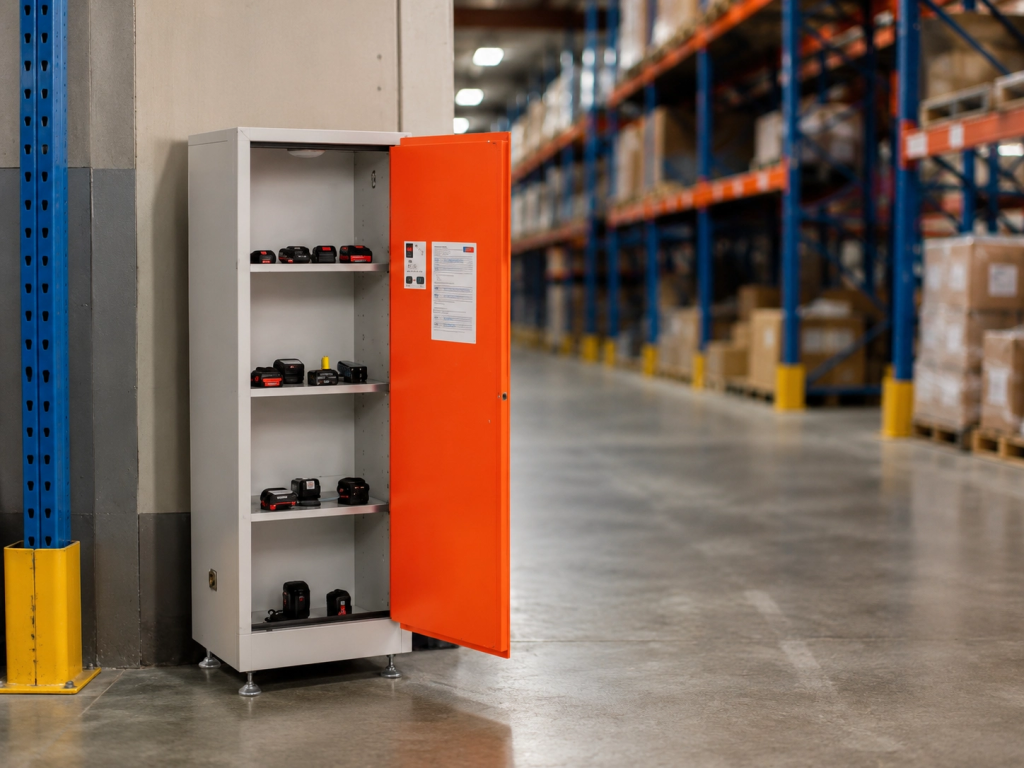
Our lithium battery storage cabinets are key to effective, resistant storage; why do businesses need them?
"To be completely transparent these cabinets are essential for businesses."
“The overall purpose of these cabinets is to give businesses a safer, more controlled way to store hazardous materials while meeting EN 14470-1 requirements. They form an important part of a responsible fire-safety and risk-management strategy.”
"It is not only about ticking a compliance box. The right cabinet can protect employees, the building and the wider business in the event of a fire, and it is also important when meeting insurance requirements."
Lance Dalrymple: Business Development Manager UK Straightforward Expertise, Protecting your Reputation. Can you tell me about your role and what a typical day looks like for you? “I am the Business Development Manager for the UK here at Hyde Park. I primarily cover the North and South West of England.” “A typical day usually starts […]
Zara Campbell: Marketing & Social Media Executive
Straightforward Expertise, Protecting your Reputation.
1. Tell us about your role at Hyde Park Environmental and what a typical day looks like.
"My role mainly focuses on Hyde Park Environmental’s digital marketing and external communications. Typically, my day starts with a marketing team plan, our top priorities for the week and meetings around product imagery, website design and upcoming campaigns."
"In the afternoon (after an intense table tennis match) I’ll usually focus on my bigger tasks, whether that’s editing videos, updating compliance blogs or heading into the warehouse to source new imagery. It’s always busy, but that variety is what makes the role so enjoyable."
2. What do you enjoy most about working at Hyde Park Environmental?
"Definitely the team. I’ve been really lucky to grow, learn and collaborate with such a supportive, engaging group of people."
"Whether I need help with videos, social content, planning or organisation, the wider sales and operations teams are always especially happy to get involved and support my ideas."

3. What is a project or achievement you’re particularly proud of?
"It has to be the Meet the Team video!"
"After a few weeks of planning, filming and editing, it was great to see everything come together. A big thank you to the wider team for getting involved, supporting the idea and providing plenty of laughs along the way... especially Dale on the piano!"
4. What drew you to the world of media, engagement and marketing and what do you enjoy most about it?
“I studied Business, English Literature and Art at A Level, so I’ve always been interested in the creative industry. I truly do enjoy writing and structuring content across different platforms here at Hyde Park and, as quite an organised person, I think my chosen career path suits my personality well!”
"That interest has led me to where I am now, and with my final year of university beginning in September, I’m excited to continue developing both professionally with the Hyde Park team and academically."
Zara Campbell: Marketing & Social Media Executive Straightforward Expertise, Protecting your Reputation. 1. Tell us about your role at Hyde Park Environmental and what a typical day looks like. “My role mainly focuses on Hyde Park Environmental’s digital marketing and external communications. Typically, my day starts with a marketing team plan, our top priorities for […]
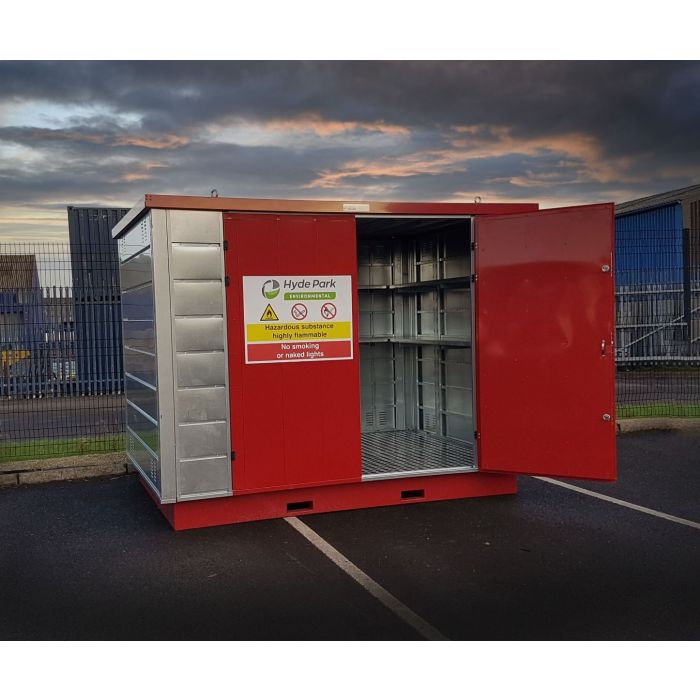
A bund is a secondary containment system designed to capture any liquid that escapes from a primary container.
If your business stores oils, fuels, chemicals or other potentially hazardous liquids, bunded storage may not just be good practice, it could be a legal requirement. Across sectors such as construction, manufacturing, utilities, transport and facilities management, businesses have a responsibility to prevent leaks and spills that could harm people, property and the environment.
How Do You Know If You Need Bunded Storage?
- Do you store oil, diesel, lubricants, chemicals or other liquids that could cause pollution?
- Are you keeping substances in drums, IBCs or tanks?
- Could a leak contaminate drains, watercourses, soil or nearby land?
- Do you operate in sectors with strict environmental compliance requirements?
- Would a spill disrupt operations or create health and safety risks?
If you answered "yes" to any of these questions, bunded storage should be seriously considered.
What Do Regulations Say?
Several organisations and regulatory bodies provide guidance on managing hazardous substances and pollution prevention:
- The Environment Agency promotes secondary containment measures to help prevent pollution incidents.
- The Health and Safety Executive (HSE) expects businesses to safely manage hazardous substances and minimise risks to employees and the environment.
- The Control of Pollution (Oil Storage) Regulations set requirements for many oil storage applications across the UK.
- Local authorities and environmental regulators can take enforcement action where inadequate containment results in pollution.
Benefits?
Bunded storage offers benefits that go far beyond simply meeting regulatory requirements. By providing secondary containment for oils, fuels and chemicals, it significantly reduces the risk of environmental contamination and the costly clean-up operations that can follow a leak or spill.
Effective containment measures also help protect your business reputation, demonstrating to customers, stakeholders and regulators that environmental responsibilities are being taken seriously. In addition, bunded storage contributes to a safer workplace by reducing the potential for hazardous substances to create slip, fire or exposure risks. It also supports ESG objectives, provides peace of mind when storing hazardous substances and helps demonstrate due diligence during audits and inspections.
Don't Wait for a Spill to Highlight a Problem
At Hyde Park Environmental, we supply a comprehensive range of bunded storage solutions, including drum stores, IBC bunds, chemical storage units, spill containment systems and secure hazardous substance storage. Our team can help assess your requirements and recommend practical, compliant solutions tailored to your site.
Need advice on bunded storage? Contact Hyde Park Environmental today.
A bund is a secondary containment system designed to capture any liquid that escapes from a primary container. If your business stores oils, fuels, chemicals or other potentially hazardous liquids, bunded storage may not just be good practice, it could be a legal requirement. Across sectors such as construction, manufacturing, utilities, transport and facilities management, […]
Although UK safety sign legislation hasn't seen any major changes in 2026, keeping your workplace signage up to date should still be a priority. Safety signs play a vital role in protecting employees, contractors and visitors by clearly highlighting hazards, directing people to emergency equipment and reinforcing safe working practices. Over time, signs can become damaged, outdated or simply overlooked, making regular reviews an important part of maintaining a safe and compliant workplace.
In this guide, we'll explain the different types of safety signs, what they mean, and how to ensure your business continues to meet the requirements of the Health and Safety (Safety Signs and Signals) Regulations 1996 while following recognised standards such as BS EN ISO 7010.
Would your employees know exactly what to follow?
What are safety signs?
Safety signs are universally recognised visual symbols designed to communicate essential health and safety information quickly and clearly. They help employers create safer workplaces by alerting people to potential hazards, providing clear instructions, and guiding them during routine tasks or emergency situations.
Safety signs are commonly used to:
- Warn employees and visitors of potential hazards or dangers
- Provide important safety instructions
- Indicate where Personal Protective Equipment (PPE) must be worn
- Prohibit unsafe or unauthorised behaviour
- Identify emergency exits, fire safety equipment and first aid facilities
Whether in warehouses, construction sites, manufacturing facilities or offices, safety signs play a vital role in reducing risks and helping businesses meet their health and safety obligations.
What do the colours of safety signs mean?
Safety sign colours are standardised to ensure they can be recognised and understood at a glance.
🔴 Red safety signs indicate prohibition, fire safety equipment or emergency stop actions. They are used to tell people what they must not do or to highlight equipment such as fire extinguishers and emergency stop buttons.
🟡 Yellow or amber signs are warning signs. They alert people to potential hazards and encourage them to take extra care or proceed with caution.
🔵 Blue safety signs are mandatory signs. They specify actions that must be followed, such as wearing personal protective equipment (PPE) including safety helmets, eye protection or high-visibility clothing.
🟢 Green safety signs provide safe condition information. They identify emergency exits, escape routes, first aid stations, safety equipment and other facilities designed to keep people safe during an emergency.
Prohibition sign
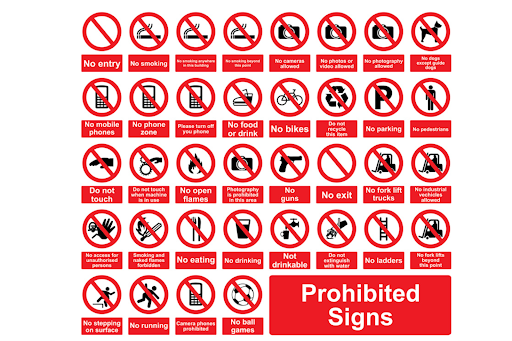
These are signs that prohibit behaviour that is likely to increase or cause danger (e.g. no smoking).
Intrinsic features:
- black pictogram on white background, red edging and diagonal red line (the red part to take up at least 35% of the area of the sign)
- round shape
Safety warning signs
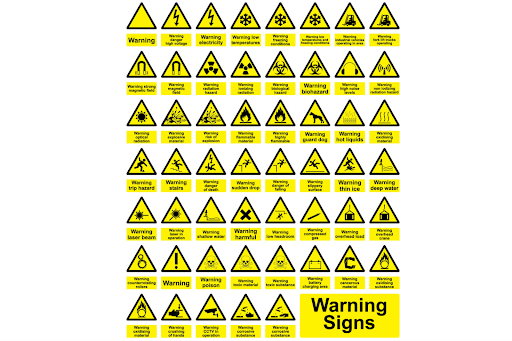
Warning sign: a sign giving warning of a hazard or danger (e.g. danger: dangerous substances)
Intrinsic features:
- triangular shape
- black picture with at least 50% yellow background
Mandatory signs
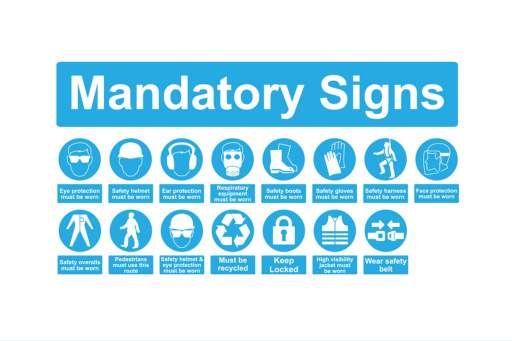
Mandatory sign: a sign prescribing specific behaviour (e.g. eye protection must be worn)
Intrinsic features:
- round shape
- white pictogram on a blue background (the blue part to take up at least 50% of the area of the sign)
Emergency signs
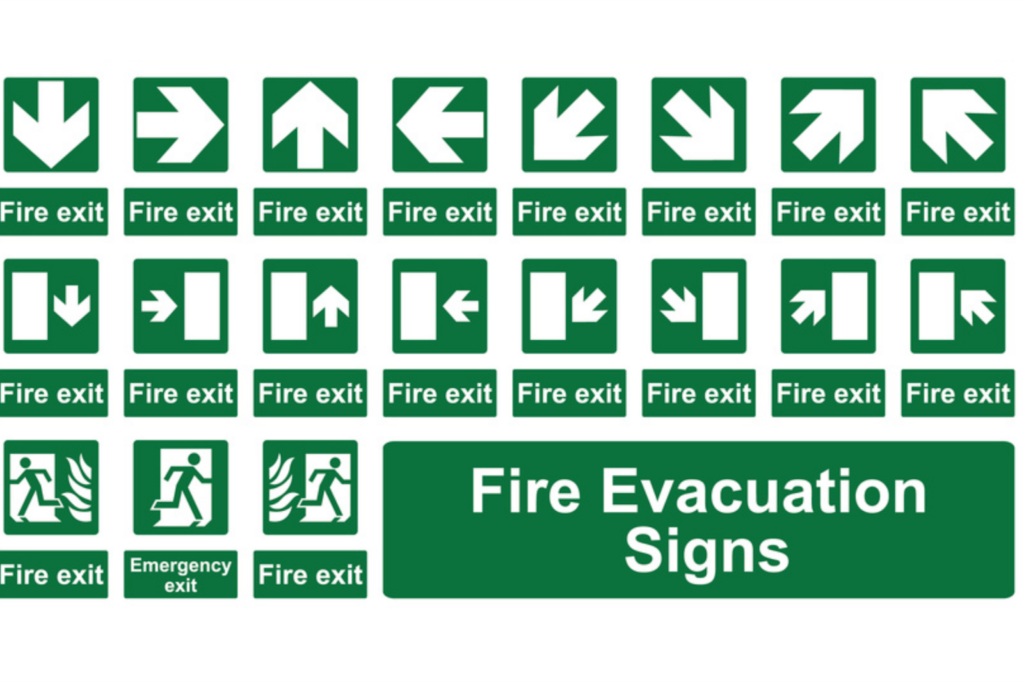
Emergency Signs: signals an emergency escape or to label escape routes.
Intrinsic features:
- White pictogram on a Green background
- Square shape
Spill kit safety signs
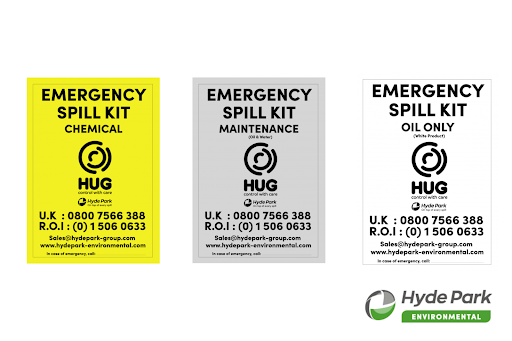
Our range of adhesive spill kit signs are designed to be highly visible and easy to understand, featuring bold text and clear messaging. Manufactured with a durable vinyl coating, these signs are suitable for a variety of workplace environments, offering long-lasting performance even in demanding conditions.
Spill kit safety signs are primarily used to identify the exact location of spill response equipment, ensuring employees can act quickly and effectively during an emergency. They are ideal for use in warehouses, manufacturing facilities, laboratories, and pharmaceutical environments where fast access to spill kits is critical.
Do I need safety signs in my workplace?
To determine if safety signs are necessary for your workplace, you firstly need to conduct a thorough risk assessment (made under the Management of Health and Safety at Work Regulations 1999).
These assessments are designed to identify hazards, the associated risks, and the required measures to be taken. Based on the outcome of the risk assessment, you can determine which types of safety signage must be put up and where.
We’re here to help
If you need more assistance or advice on the type of spill kit safety signs you need? Get in touch with Hyde Park Environmental today.
Straightforward Expertise, Protecting your Reputation.
Although UK safety sign legislation hasn’t seen any major changes in 2026, keeping your workplace signage up to date should still be a priority. Safety signs play a vital role in protecting employees, contractors and visitors by clearly highlighting hazards, directing people to emergency equipment and reinforcing safe working practices. Over time, signs can become […]
Many businesses invest in spill control equipment, simply having a spill kit on site isn't enough. Without the right preparation, training and procedures, even a small spill can quickly become a safety hazard, cause environmental damage and lead to costly clean up operations or regulatory action.
First… What's in a Spill Kit?
A spill kit is designed to help contain, absorb and safely dispose of accidental spills before they spread. The exact contents vary depending on whether it's an oil-only, chemical or general-purpose spill kit, but most include:
- Absorbent pads for soaking up liquids
- Absorbent socks or booms to contain spills
- Absorbent pillows for larger leaks
- Disposable gloves and PPE
- Waste disposal bags and ties
- Spill response instructions
Selecting the correct spill kit for the liquids used on your site is the first step towards effective spill response.
Top 5 Spill Control Mistakes Businesses Make
1. Choosing the Wrong Spill Kit
Not all spills are the same. Using an oil-only kit on chemicals, or relying on a general-purpose kit for hazardous substances, can make clean-up ineffective and potentially dangerous.
How to avoid it:
Carry out a site risk assessment and identify every liquid stored or used on-site. Ensure the correct spill kits are available in suitable sizes and quantities for each area.
2. Storing Spill Kits Too Far Away
When a spill occurs, every second counts. If spill kits are locked away or located on the opposite side of the building, valuable time is lost while the spill continues to spread.
How to avoid it:
Position spill kits beside high-risk areas such as chemical storage, fuel tanks, loading bays, maintenance workshops and production lines. They should always be clearly visible and easy to access.
3. Not Training Employees
One of the biggest causes of poor spill response isn't the equipment—it's uncertainty. Employees who don't know how to use a spill kit may hesitate or respond incorrectly.
How to avoid it:
Provide regular spill response training so staff understand how to:
- Assess the spill safely
- Protect themselves with PPE
- Stop the source if safe to do so
- Contain the spill
- Dispose of contaminated absorbents correctly
4. Failing to Inspect and Restock Spill Kits
After a spill has been cleaned up, absorbents and PPE are often not replaced, leaving the kit incomplete when it's needed next.
How to avoid it:
Include spill kits in routine workplace inspections. Replace any used or damaged contents immediately and check expiry dates where applicable.
5. Focusing on Clean-Up Instead of Prevention
Many businesses only think about spills after they've happened. In reality, preventing spills is far more effective than cleaning them up.
How to avoid it:
Reduce the risk by investing in preventative solutions such as:
- Spill pallets
- Drip trays
- Bunded storage units
- Hazardous substance storage
- Proper drum handling equipment
A proactive approach significantly reduces the likelihood of environmental incidents and costly downtime.
What Does the Guidance Say?
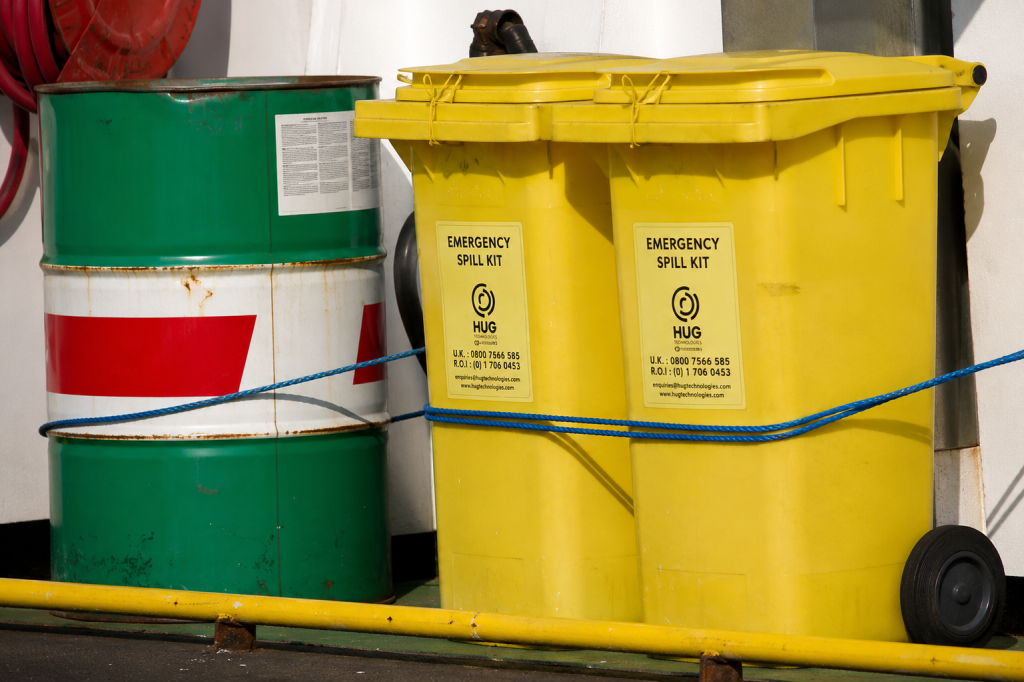
In the UK, employers have a legal responsibility to prevent pollution and manage hazardous substances safely. Guidance from the Health and Safety Executive (HSE) and the Environment Agency recommends that workplaces handling oils, fuels or chemicals have suitable spill response equipment readily available, ensure employees receive appropriate training, and implement measures to prevent spills wherever possible.
Businesses should also regularly review their spill response procedures, inspect spill control equipment and ensure contaminated waste is disposed of in accordance with environmental regulations. Having the correct spill control products in place is not only good practice but it also helps demonstrate compliance with health, safety and environmental legislation.
How Hyde Park Environmental Can Help
At Hyde Park Environmental, we understand that every workplace has different spill control requirements. That's why we supply a comprehensive range of spill response and spill prevention solutions to suit every industry.
From oil, chemical and general-purpose spill kits to spill pallets, absorbents, drip trays, hazardous storage units and bunded storage, our products are designed to help businesses stay safe, compliant and prepared.
Whether you're reviewing your current spill control strategy or equipping a new site, our experienced team can help you select the right products for your workplace.
Need advice on the best spill control solution for your business? Contact Hyde Park Environmental today or browse our full range of spill control products online.
Many businesses invest in spill control equipment, simply having a spill kit on site isn’t enough. Without the right preparation, training and procedures, even a small spill can quickly become a safety hazard, cause environmental damage and lead to costly clean up operations or regulatory action. First… What’s in a Spill Kit? A spill kit […]
No matter how robust your storage and handling procedures are, workplace spills can still occur. According to the Health and Safety Executive (HSE), every workplace that stores or uses hazardous substances should have suitable emergency procedures in place, along with trained personnel and appropriate spill response equipment.
Having a clear spill response plan in place can make all the difference. Here's a step-by-step guide on what to do when a spill happens.
Step-by-Step Spill Response Guide
Step 1: Stop and Assess the Situation
Before taking any action:
- Identify the substance that has been spilled.
- Check for any immediate danger to people.
- Determine whether the spill can be safely managed by trained employees.
- If there is a serious risk to health or safety, evacuate the area and contact the emergency services.
Step 2: Secure the Area
Reduce the risk of further harm by:
- Keeping unauthorised personnel away.
- Using cones or warning signage.
- Stopping vehicle and pedestrian traffic.
- Removing ignition sources if flammable liquids are involved.
Step 3: Put on the Correct PPE
Before approaching the spill:
- Wear suitable chemical-resistant gloves.
- Use eye protection where required.
- Wear coveralls or protective clothing.
- Use respiratory protection if recommended by the Safety Data Sheet.
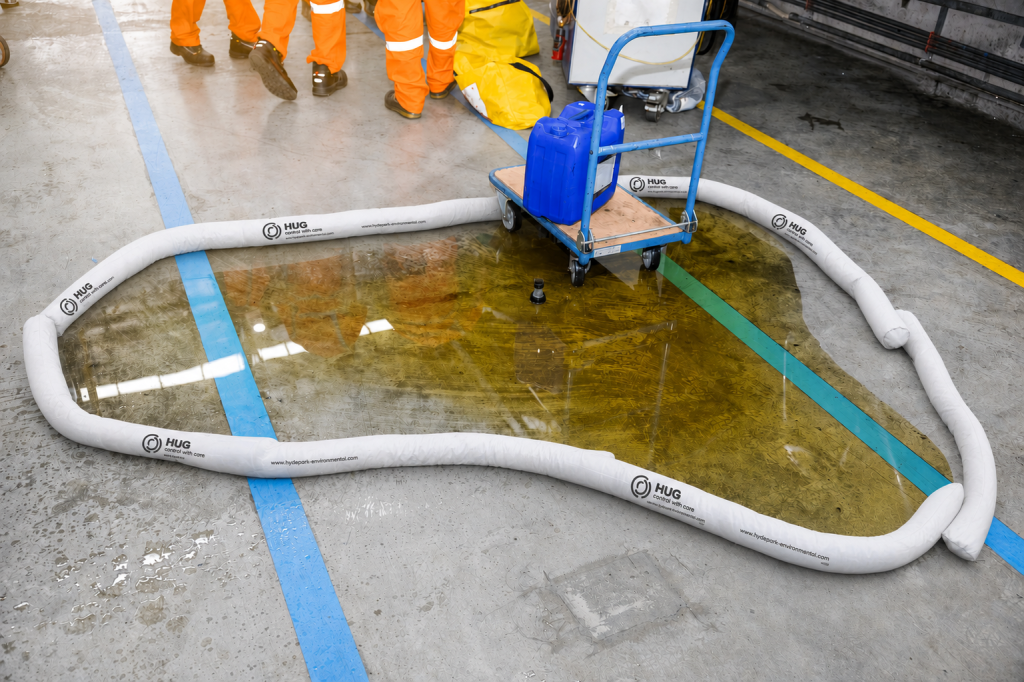
Step 4: Contain the Spill
Prevent the spill from spreading by:
- Placing absorbent socks or booms around the spill.
- Protecting nearby drains with drain covers or mats.
- Stopping the leak at its source if it is safe to do so.
- Preventing contamination of watercourses or surrounding land.
Step 5: Clean Up Safely
Once the spill is contained:
- Use the correct absorbents for the liquid involved.
- Collect contaminated absorbent materials.
- Place waste into suitable disposal bags or containers.
- Dispose of waste in accordance with environmental regulations.
Step 6: Report and Restock
After the clean-up:
- Record the incident.
- Investigate the cause to prevent recurrence.
- Replace any spill kit items that were used.
- Review whether additional spill prevention measures are required.
What Do UK & Irish Safety Authorities Recommend?
The HSE, HSENI and environmental regulators all promote a proactive approach to spill management. Their guidance recommends that businesses should:
- Carry out regular COSHH risk assessments.
- Train employees in spill response procedures.
- Keep spill kits close to areas where hazardous substances are stored or used.
- Protect drains from contamination.
- Regularly inspect storage areas and containers.
- Maintain written emergency response procedures.
- Review spill incidents to improve future preparedness.
These simple measures can significantly reduce environmental impact while helping businesses meet their legal responsibilities under COSHH and environmental protection legislation.
How Hyde Park Environmental Can Help:
Having the right equipment on-site can make all the difference when a spill occurs.
We supply everything needed for an effective spill response, including spill kits, absorbents, drain protection, spill pallets, bunded storage and COSHH-compliant chemical storage solutions. Our team can also carry out site visits to assess your current storage arrangements, identify potential risks and recommend the most appropriate spill prevention equipment for your workplace.
Whether you're looking to improve compliance, upgrade your spill response capabilities or future-proof your site, our experts are here to help.
No matter how robust your storage and handling procedures are, workplace spills can still occur. According to the Health and Safety Executive (HSE), every workplace that stores or uses hazardous substances should have suitable emergency procedures in place, along with trained personnel and appropriate spill response equipment. Having a clear spill response plan in place […]